
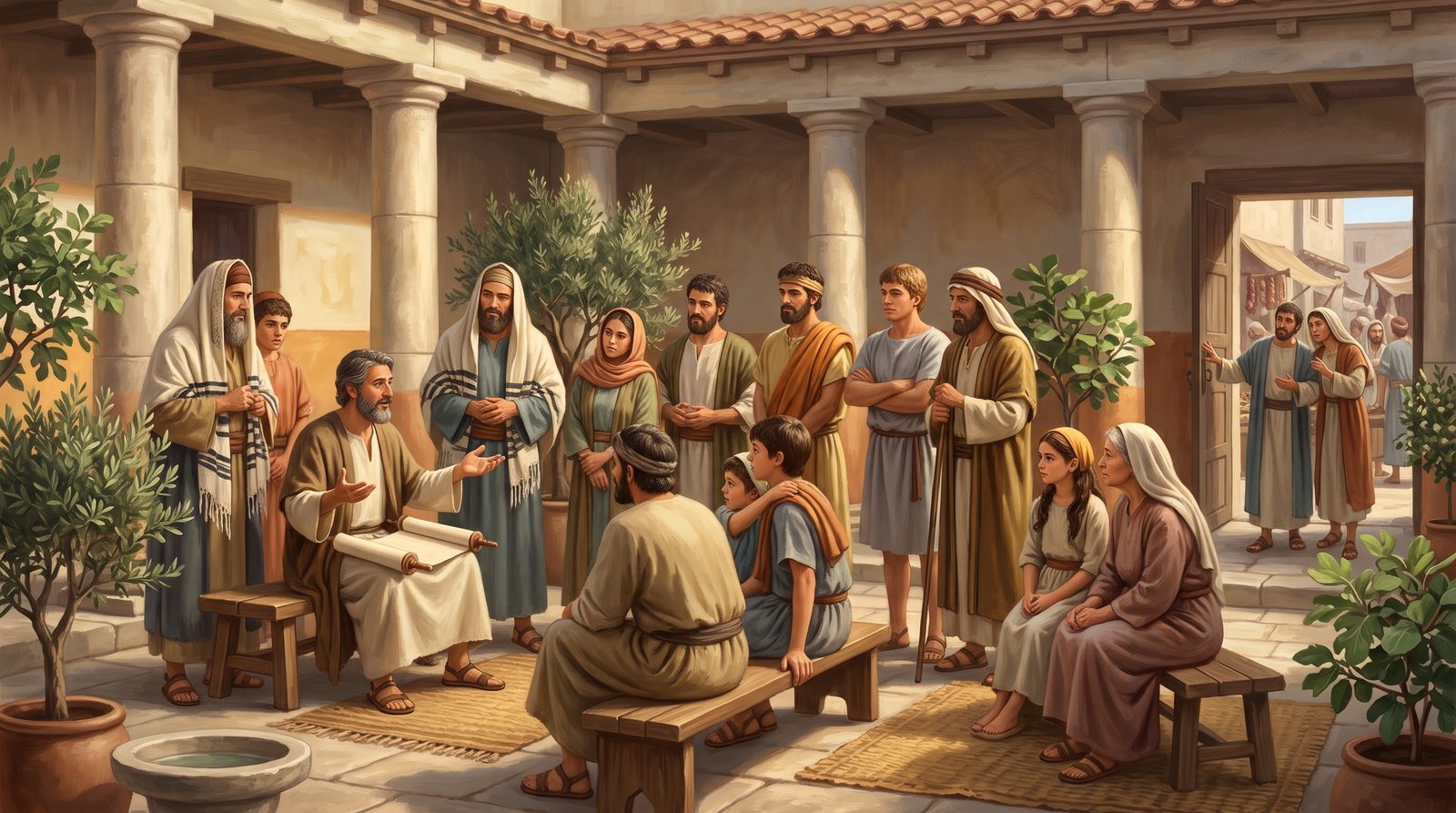
They aren’t the same church, and they aren’t related, even though the names sound nearly alike. “Church of God” is a name worn by several separate bodies. The two you’ll hear about most are the Church of God (Cleveland, Tennessee), which is Pentecostal, and the Church of God (Anderson, Indiana), a holiness body that isn’t. The Church of God in Christ, based in Memphis, is another. Here at Christians In Honesdale, we part ways with these groups over how a congregation is overseen, over speaking in tongues, over the reason for baptism and over the way we worship.
Each of those bodies teaches for itself. So we’ll name the one we mean as we go.
Two Bible Phrases on Two Different Signs
Neither name was made up. Paul addressed his first letter to Corinth “To the church of God that is in Corinth” (1 Corinthians 1:2). When he wrote to Rome, he passed along greetings from many congregations with the words “All the churches of Christ greet you” (Romans 16:16).
Both phrases say who the church belongs to. The church is God’s, and it’s Christ’s. That’s exactly why a name can’t settle much on its own, since two buildings can each quote the Bible on the sign and still teach very different things inside. We identify as a church of Christ, that is, a church that belongs to Christ. And so we go by the name the disciples were first given at Antioch, Christians (Acts 11:26).
Three Bodies That Share One Name
The Cleveland body dates its start to 1886. That year R. G. Spurling and eight others organized a small fellowship in Monroe County, Tennessee, called the Christian Union. It began among Baptists, and a revival in 1896 drew it into the holiness movement, which stressed a sanctified, set-apart life. It took the name Church of God in 1907. In the early 1900s it turned Pentecostal. That movement expects the Spirit’s miraculous gifts, tongues among them, in the church today. An International General Assembly now governs the body and elects a general overseer, and the body holds to a written Declaration of Faith.
The Anderson body is older. It goes back to 1881 and a preacher named Daniel S. Warner. This body belongs to the holiness movement too, but it doesn’t share Pentecostal practices. Its congregations run their own affairs and cooperate through a national office called Church of God Ministries. It has no formal creed (a written summary of doctrine that members are expected to hold), and it keeps no official membership.
The Church of God in Christ was formed in 1897, and Charles Harrison Mason and Charles Price Jones are its best-known founders. The body is holiness-Pentecostal, with its headquarters in Memphis, and a presiding bishop leads it.
Same name. Separate histories.
What We Share With Them
We do share real ground with them. The Anderson body has long refused human creeds and the walls that divide denominations, and that’s close to our own conviction that the Bible alone is enough. All of these bodies baptize by immersion, which means the whole person goes under the water. And many of their members love the Bible and take holy living seriously. We’re glad of that.
Who Oversees a Congregation
The Cleveland body and the Church of God in Christ each have a general assembly, with a general overseer or a presiding bishop serving over the whole church. The Anderson congregations manage their own affairs, though they cooperate through Church of God Ministries.
The New Testament shows us something smaller. Paul and Barnabas appointed elders in every church (Acts 14:23), men who watched over that one congregation, and Peter told elders to “shepherd the flock of God that is among you” (1 Peter 5:2). Among you. That’s the pattern we hold ourselves to, so no board, assembly or office has any say over this congregation.
We’re still on the way in one respect. We’re a small congregation, and right now none of our men meet the qualifications Paul lays out for elders (1 Timothy 3:1-7; Titus 1:5-9), so we don’t have elders yet, and we won’t appoint anyone just to fill the title. Until the Lord raises up qualified men among us, we work together as a congregation under Christ and His word.
It cuts the other way, too. With nothing above us, nobody here speaks for any other church, and this page only describes what’s taught and practiced at 416 Main Street, Suite D.
Tongues, Gifts and the Finished Word
The Cleveland body’s Declaration of Faith calls speaking in tongues “the initial evidence” of baptism in the Holy Ghost, and the Church of God in Christ teaches the same. Both expect the Spirit’s miraculous gifts in the church today.
We understand those gifts differently. In the first century they confirmed the message while God was still revealing it (Hebrews 2:3-4). Paul said they wouldn’t last, writing that “as for tongues, they will cease” (1 Corinthians 13:8). Once the faith had been delivered in full (Jude 3), the confirming signs had finished their work. None of that means God has gone quiet. He still hears prayer, and He still works through His providence, the unseen way He guides events for His people. We just don’t look for new revelation. Scripture already gives us what we need.
The Reason for Baptism
The Anderson body counts baptism among what it calls symbolic acts. The Cleveland body’s Declaration of Faith teaches immersion for all who repent.
We read the purpose of baptism in the first gospel sermon after Jesus rose. Peter told the crowd, “Repent and be baptized every one of you in the name of Jesus Christ for the forgiveness of your sins” (Acts 2:38). Saul of Tarsus was later told to be baptized and wash away his sins (Acts 22:16), and Peter wrote that baptism saves (1 Peter 3:21). So we teach that a believer’s sins are forgiven when he’s immersed, and we don’t treat baptism as a picture of something that happened earlier. The gap is real. It may be the most important one on this page.
Singing With No Instruments
Our worship will probably sound different from most churches you’ve visited. We sing a cappella, which means with voices only, because the New Testament describes Christians “singing and making melody to the Lord with your heart” (Ephesians 5:19; see Colossians 3:16). The instrument Paul names there is the heart. And every first day of the week we observe the Lord’s Supper together, the bread and the cup, the way the early disciples did when they gathered on that day (Acts 20:7).
Reading Past the Sign
A sign tells you which name a church picked. It can’t tell you whether that church is following the New Testament. Open Acts 2, then 1 Corinthians 12 through 14, and read them slowly, watching what they say about the Spirit’s gifts and baptism and worship.
Talk It Through With Us
If you grew up in a Church of God congregation, or you’ve been visiting one, we’d be glad to read those chapters with you and take your questions one at a time. Set up a Bible study, read more about who we are, or drop us a note whenever you’re ready.
Our weekly schedule:
We meet in Suite D at 416 Main Street in Honesdale, PA 18431. Pull around back to park, and you’ll find our door at the rear of the building.