
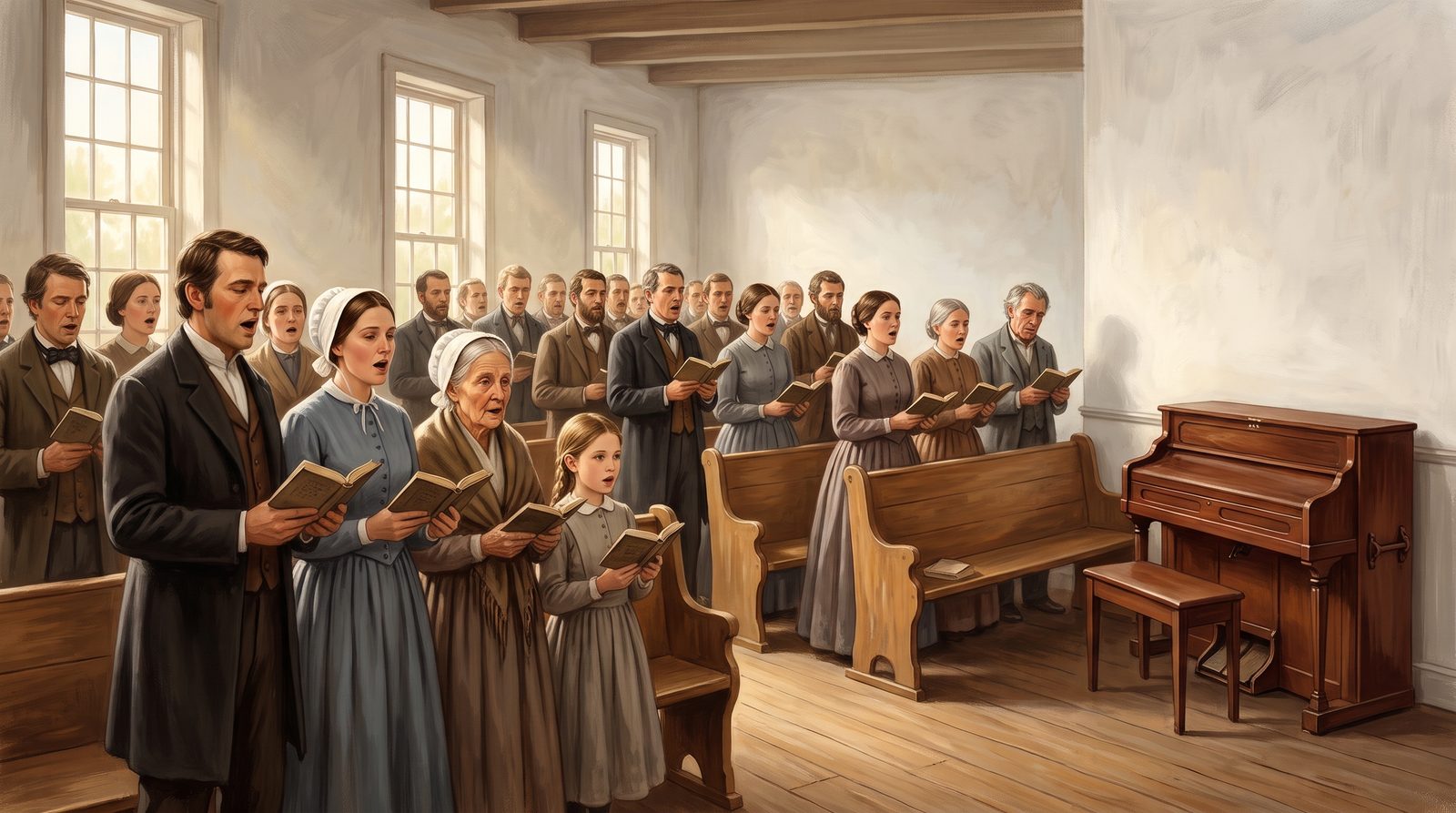
They started out as one movement and split over two questions about Bible authority. In the early 1800s, the congregations that became churches of Christ and the ones that became the Christian Church stood together, urging believers to drop human creeds and go back to the Bible alone. Then two new practices arrived: a missionary society organized above the local congregations, and instruments in worship. By 1906 the break was official, and the federal census of religious bodies counted churches of Christ as a separate group.
Plenty of people still figure these are the same church with different signs out front. They aren't. How they came apart is worth a few minutes of your time.
One Movement With Bible Names
In the early 1800s, preachers from different churches reached the same conclusion on their own. In Kentucky, Barton W. Stone and several fellow Presbyterian ministers dissolved their presbytery in 1804. They wrote a document called the Last Will and Testament of the Springfield Presbytery, declaring that the body should "die, be dissolved, and sink into union with the Body of Christ at large." In western Pennsylvania, Thomas Campbell, a Presbyterian minister from Ireland, and his son Alexander were pleading for the same thing. At a meeting in Washington County, Pennsylvania, in 1809, Thomas summed it up in a sentence his followers repeated for generations: "Where the Scriptures speak, we speak; where the Scriptures are silent, we are silent."
Remember that motto. Both of the questions that later divided this movement came down to what it means.
The plea grew out of Jesus' own prayer for His followers, "that they may all be one" (John 17:21). In 1832 the Stone and Campbell movements joined in Lexington, Kentucky. The congregations that answered the plea wore names taken straight from the Bible (Acts 11:26; Romans 16:16). Stone preferred to call them Christians. Alexander Campbell preferred disciples. Congregations went by church of Christ, Christian church, or disciples of Christ.
We use the plainest of those names ourselves. Here at Christians In Honesdale we're simply Christians, since that's what the disciples were first called in Antioch (Acts 11:26).
A family likeness survives even now. The Disciples still observe the Lord's Supper every week, just as we do (Acts 20:7). The movement's early preachers taught that a believer should be immersed for the forgiveness of sins (Acts 2:38; Romans 6:3-4). Many Disciples congregations today also receive members who were baptized in other ways, but that was the movement's early teaching.
The Missionary Society Question
The first crack showed in 1849. That year the American Christian Missionary Society was formed in Cincinnati to raise money and send out evangelists, and Alexander Campbell was chosen as its first president. That surprised some people. Twenty-some years earlier, Campbell's own paper, the Christian Baptist, had attacked missionary societies as having no place in the New Testament. Now he led one.
Lots of people thought the society was just a practical way to spread the gospel faster. Others hesitated. Their question was harder. Where does the New Testament give the church any organization bigger than the local congregation to do its work?
They couldn't find one. Each congregation in Scripture had its own elders (Acts 14:23), and those men were told to "shepherd the flock of God that is among you" (1 Peter 5:2). When churches helped a preacher, the help went straight to him. Paul reminded the church at Philippi of exactly that: "And you Philippians yourselves know that in the beginning of the gospel, when I left Macedonia, no church entered into partnership with me in giving and receiving, except you only. Even in Thessalonica you sent me help for my needs once and again" (Philippians 4:15-16). Paul says the same about other churches: "I robbed other churches by accepting support from them in order to serve you" (2 Corinthians 11:8). No board sat between the congregation and the work.
A note on the Greek: "Entered into partnership" is koinōneō, the verb form of koinōnia, "fellowship" or "sharing." The church at Philippi shared directly with Paul. No agency collected the money and passed it along. In 1 Peter 5:2, "the flock of God that is among you" is to en hymin poimnion. The elders' oversight reached the flock among them, their own congregation, and no further.
The Instrument Question
Around 1860, a congregation in Midway, Kentucky, put a melodeon (a small reed organ) into its worship. Its preacher, L. L. Pinkerton, allowed it. Alexander Campbell had already given his opinion in 1851. Writing in the Millennial Harbinger, he said that to spiritually minded Christians such aids would be "as a cow bell in a concert." Even so, over the decades that followed, more congregations brought in instruments.
Nobody argued about whether Christians should sing. The New Testament says so plainly: "Let the word of Christ dwell in you richly, teaching and admonishing one another in all wisdom, singing psalms and hymns and spiritual songs, with thankfulness in your hearts to God" (Colossians 3:16). Ephesians says the same thing: "addressing one another in psalms and hymns and spiritual songs, singing and making melody to the Lord with your heart" (Ephesians 5:19).
A note on the Greek: "Making melody" is psallontes, from psallō. Centuries before the New Testament, the word meant plucking a string, and some argued in the 1800s that it brought the harp along with it. But Paul names what is played: tē kardia, "with your heart." In the New Testament, psallō means singing praise (Romans 15:9; 1 Corinthians 14:15; James 5:13), and the only instrument Ephesians 5:19 mentions is the heart.
The real argument was over what the Bible leaves unsaid. One side held that silence leaves us free. The other held that silence grants no permission at all, and they pointed to the very next verse: "And whatever you do, in word or deed, do everything in the name of the Lord Jesus, giving thanks to God the Father through him" (Colossians 3:17). Doing something in His name means doing it on His authority.
A note on the Greek: "In the name" is en onomati. In the New Testament, acting in someone's name means acting by his authority. When the rulers in Jerusalem questioned Peter and John, they asked, "By what power or by what name did you do this?" (Acts 4:7). Name and power were the same question.
Hebrews reasons the same way. Its writer explains why Jesus couldn't have served as a priest under the Law of Moses: "For it is evident that our Lord was descended from Judah, and in connection with that tribe Moses said nothing about priests" (Hebrews 7:14). Moses never banned priests from Judah. He simply never authorized them. That was enough.
The Old Testament has a sharper example. Aaron's sons Nadab and Abihu "offered unauthorized fire before the LORD, which he had not commanded them. And fire came out from before the LORD and consumed them" (Leviticus 10:1-2). God hadn't forbidden that fire. He just hadn't commanded it.
A note on the Hebrew: "Unauthorized fire" is ʾēš zārāh, literally "strange" or "foreign" fire. It was fire from somewhere God hadn't named. The text gives no list of prohibitions they broke. It gives one reason: ʾăšer lōʾ ṣiwwāh ʾōtām, "which He had not commanded them." The offense was doing what God hadn't asked for.
When the Break Became Official
The debate dragged on for decades, in religious papers and from pulpits. Congregations divided. Families landed on opposite sides, and it hurt. The two questions didn't always line up, either. J. W. McGarvey, a respected Bible scholar in Kentucky, opposed the instrument but supported the society, and he stayed with the Christian Church.
In 1906, S. N. D. North, director of the federal census of religious bodies, asked whether the movement had in fact divided. David Lipscomb, editor of the Gospel Advocate in Nashville, told him it had, and the census listed the two separately.
It didn't stop there. Starting in the 1920s, a more conservative group of instrumental congregations slowly separated from the Disciples, and today they're known as the independent Christian Churches. They use instruments, but each one governs itself. In 1968 the Disciples reorganized as the Christian Church (Disciples of Christ), a denomination with a General Assembly and regional offices, and the break between those two was formal soon after.
So a searcher can run into three groups today with shared roots and names that are easy to mix up. The independent group's own collective name is "Christian Churches and Churches of Christ," so a sign reading "Church of Christ" doesn't always tell you which one you've found. The simplest way to tell is to ask whether they sing a cappella.
Where We Stand on Both Questions
We don't go by either group's name, and no denomination or headquarters stands behind us. We're one independent congregation, so we can only speak for what's taught here. On both of these questions, though, we stand where the congregations that turned down the society and the instrument stood, and for the same reason. It isn't stubbornness. It has nothing to do with taste in music, either. We believe the New Testament is the pattern, and we don't think we're free to add to worship or to the church's work what it doesn't authorize. God told Israel, "You shall not add to the word that I command you, nor take from it" (Deuteronomy 4:2). Paul gave the same principle when he wrote to Corinth, "that you may learn by us not to go beyond what is written" (1 Corinthians 4:6).
So we sing without instruments. We also do our work as a congregation, with no society or board standing over us. We haven't told this story to score a point. Many people in the Christian Church love the Bible, and we'd gladly open these passages with any of them.
Let the Text Settle It
History can tell you how the split happened. It can't tell you who was right. Only Scripture can. Read Colossians 3 and Philippians 4 slowly, ask what they authorize, and let the text give the answer.
Open Colossians 3 With Us
If you'd like to work through those chapters with someone, we'll sit down with you one-on-one, or you can join our Tuesday night Bible study online from your own kitchen table. Either way, your questions set the pace. Request a Bible study, get to know who we are, or send us a message if you'd rather talk first.
When we meet:
Sunday worship is at 10am in Suite D of 416 Main Street, Honesdale, PA 18431, and you'll come in from the back, where the parking is.