
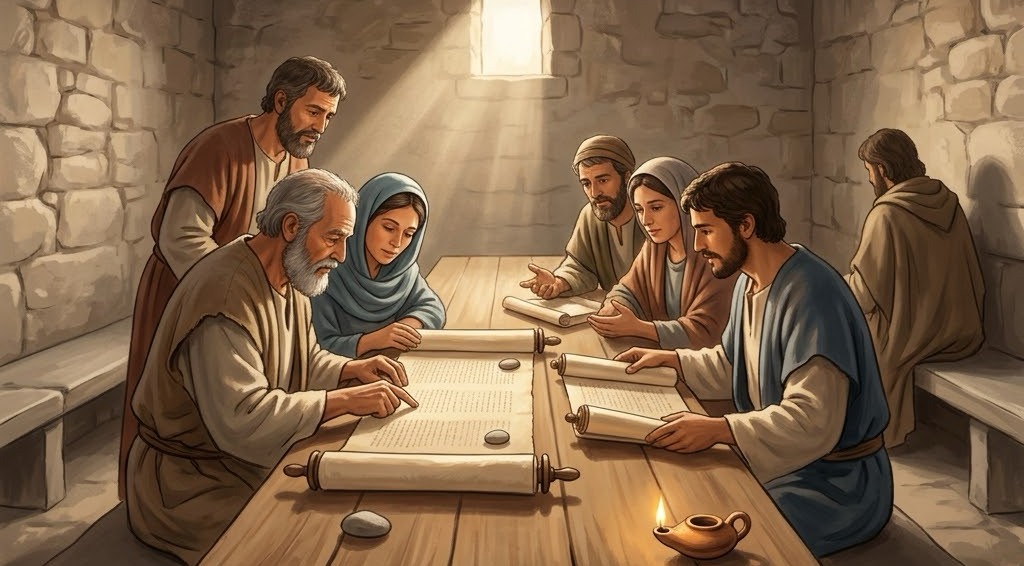
Here at Christians In Honesdale, we don't use a creed. A creed (the word comes from the Latin credo, "I believe") is a formal written summary of what a church believes, such as the Apostles' Creed or the Westminster Confession. We go without one because we believe the Bible is already complete and enough, so when someone asks what we believe, we hand them the New Testament and open it together.
The Worry Behind the Question
That answer can leave a person uneasy. Without an official statement on paper, how would you ever know what a congregation teaches? Couldn't everybody just believe whatever suits them?
Fair enough. We'll get there, after a look at why creeds were written at all.
Creeds Started With a Real Need
The earliest creeds weren't written to cause trouble. Christians wanted short summaries for teaching new believers, and they needed a way to answer people who were spreading false ideas about Jesus. Even the Apostles' Creed, despite its name, wasn't written by the apostles. It grew out of a confession used at baptisms in the church at Rome, and its familiar wording wasn't settled until centuries after the apostles had died. The Nicene Creed came out of a council that met in AD 325, and it was expanded in 381.
Much later, the Reformers rallied around the phrase sola scriptura, "Scripture alone." Their churches still went on to produce far longer documents, among them the Augsburg Confession for Lutherans in 1530 and the Westminster Confession for Presbyterians in the 1640s. Following the Bible alone turned out to be easier to say than to keep.
Plenty of the men who wrote these creeds were devout. We'd agree with a good deal of what the early creeds say about Jesus, too. He's God's Son, and He rose from the grave. We believe that because the Bible teaches it (John 20:31; 1 Corinthians 15:3-4).
Our concern is narrower. It starts when a creed becomes the test of who counts as a faithful Christian.
Isn't the Bible Full of Creeds?
In a way, yes, and it's a fair point to raise. Israel confessed its faith in the words of the Shema: "Hear, O Israel: The LORD our God, the LORD is one" (Deuteronomy 6:4). Paul gave the Corinthians a compact summary of the gospel: "For I delivered to you as of first importance what I also received: that Christ died for our sins in accordance with the Scriptures, that he was buried, that he was raised on the third day in accordance with the Scriptures" (1 Corinthians 15:3-4). Timothy "made the good confession in the presence of many witnesses" (1 Timothy 6:12).
A note on the Greek: "I delivered" and "I received" are paredōka and parelabon, the ordinary words for handing on something entrusted to you. Paul isn't composing a summary of his own. He's passing along what he was given, and he insists elsewhere that he received it "through a revelation of Jesus Christ" (Galatians 1:12). Jude uses the same verb, paradidōmi, for "the faith that was once for all delivered to the saints" (Jude 3).
We have nothing against a good summary. The difference is that these summaries are part of inspired Scripture. Nobody had to call a council to approve them. The confession we ask of someone before baptism is the one the New Testament itself gives, the one Peter made: "You are the Christ, the Son of the living God" (Matthew 16:16; Romans 10:9-10). It isn't a document that came along later.
Scripture Leaves Nothing Unfinished
Paul put it this way in a letter to Timothy. "All Scripture is breathed out by God and profitable for teaching, for reproof, for correction, and for training in righteousness, that the man of God may be complete, equipped for every good work" (2 Timothy 3:16-17).
A note on the Greek: "Breathed out by God" is a single word, theopneustos, "God-breathed." Scripture's origin is God's own breath. And Paul plays on one root in verse 17. "Complete" is artios, "fit, capable," and "equipped" is exērtismenos, "fully fitted out." Read literally, he says Scripture makes the man of God fit, fitted out for every good work. Nothing is left over for a later document to supply.
Think about that word complete. If God's word already equips a Christian for every good work, there's no gap left over for a council to fill. Peter said much the same. "His divine power has granted to us all things that pertain to life and godliness" (2 Peter 1:3). All things. And Jude urged believers to "contend for the faith that was once for all delivered to the saints" (Jude 3). The faith was handed over once, and it was handed over whole, so nobody in the fourth century or the sixteenth had to finish it.
A note on the Greek: "Once for all" is hapax. The book of Hebrews uses the same word for the cross: Christ "has appeared once for all at the end of the ages to put away sin by the sacrifice of himself" (Hebrews 9:26). He won't be offered again, and the faith won't need to be delivered again. Both were done once, and both were done completely.
An Old Saying Worth Repeating
You may run across an old saying about creeds. If a creed says more than the Bible, it says too much. If it says less, it says too little. And if it says the very same thing, we've already got it in the Bible.
The saying is old, but the idea behind it is older than the church. Moses told Israel, "You shall not add to the word that I command you, nor take from it, that you may keep the commandments of the LORD your God that I command you" (Deuteronomy 4:2). And the book of Proverbs says, "Every word of God proves true; he is a shield to those who take refuge in him. Do not add to his words, lest he rebuke you and you be found a liar" (Proverbs 30:5-6).
A note on the Hebrew: In Deuteronomy 4:2, "add" is lōʾ tōsipû, from yāsap, "to add to" or "increase," and "take from" is lōʾ tigrəʿû, from gāraʿ, "to cut back" or "diminish." Those are the two mistakes the old saying warns about, saying more and saying less. Proverbs 30:6 uses the same verb, yāsap: "Do not add to his words." The New Testament closes its last book with a similar warning about that book's own words (Revelation 22:18-19).
When a Signature Decides Who Belongs
Paul begged the Christians in Corinth "that all of you agree, and that there be no divisions among you" (1 Corinthians 1:10). Written creeds have often pulled the other way. Over the centuries they've become the very lines that separate believers, so that a person can love Jesus deeply and still be turned away for declining to sign a particular confession. At that point a document written by men is deciding who's in.
Many denominations are defined by a confession like that. A denomination is a separate religious body with its own name and structure, and with a statement of faith that marks it off from the rest. We'd rather stand on a book any Christian can pick up and read. Paul's rule was "not to go beyond what is written" (1 Corinthians 4:6), and that's the line we try to keep.
A note on the Greek: "What is written" is ha gegraptai. The verb is in the perfect tense, which describes something done in the past that still stands: it was written, and it stays written. It's the same form Jesus used three times when He answered the devil in the wilderness, "It is written" (Matthew 4:4, 7, 10). Jesus quoted Scripture to settle the question.
Isn't "No Creed but the Bible" Just Another Creed?
Some people answer that "the Bible is our only creed" is a creed of its own. In a loose sense it is a conviction, and we'd own that. But it adds no articles of faith and asks for no signature. It points away from itself to a book you can check, and that book claims to be enough (2 Timothy 3:16-17). If anyone could show us from Scripture that God requires us to sign a later confession, we'd have to sign it. We haven't found that passage.
Ask Us Where It's Written
So how would you know what we believe? Ask. We'll open the Bible and show you the passage. Every belief we hold ought to have one behind it, and if we can't point to it, we should let that belief go. Peter put it plainly: "whoever speaks, as one who speaks oracles of God" (1 Peter 4:11). Whoever teaches is to speak God's words, not his own.
That standard binds the people up front more than anyone. In the New Testament, the elders, the qualified men who oversee a congregation, were charged to "hold firm to the trustworthy word as taught" (Titus 1:9), and James warned that those who teach "will be judged with greater strictness" (James 3:1). If something Drew De Grado, our evangelist (the man who preaches for us), says on a Sunday morning in Suite D leaves you wondering where it came from, ask him for the verse.
Nobody outside this congregation writes our beliefs for us, either. We're one independent congregation, self-governing under Christ with no denomination or headquarters over us. That means we answer for our own teaching, and we can't vouch for every group of believers that reads the Bible the way we do.
No Creed Doesn't Mean No Convictions
Going without a creed doesn't mean believing whatever you like. It means God's word does the deciding, and all of us sit under it. Read it slowly. Then question anyone who teaches you, the way the people of Berea checked even Paul's preaching: "they received the word with all eagerness, examining the Scriptures daily to see if these things were so" (Acts 17:11). Luke calls them noble for it, and that includes checking us.
Bring Your Bible to Main Street
We'd be glad to read these passages with you, whether that's across a table on Sunday or on a video call some Tuesday night. Come with your questions and whatever Bible you already own. You can set up a free Bible study, learn who we are, or reach out before your first visit.
Our weekly gatherings:
The building is 416 Main Street in Honesdale, PA 18431, and we meet in Suite D. Pull around to the back of the building to park, since that's where our door is.