
Here at Christians In Honesdale, we believe the Holy Spirit is God, a person and not a force. He gave us the Scriptures. He works through the gospel, the good news about Jesus, to bring people to Christ, and He lives in every Christian. What we don't believe is that He's giving new revelation today, or the miraculous gifts the first Christians had. If that's not what you're used to, you might wonder where that leaves Him in our worship, and that's what this post is about.
A Sunday That Feels Different
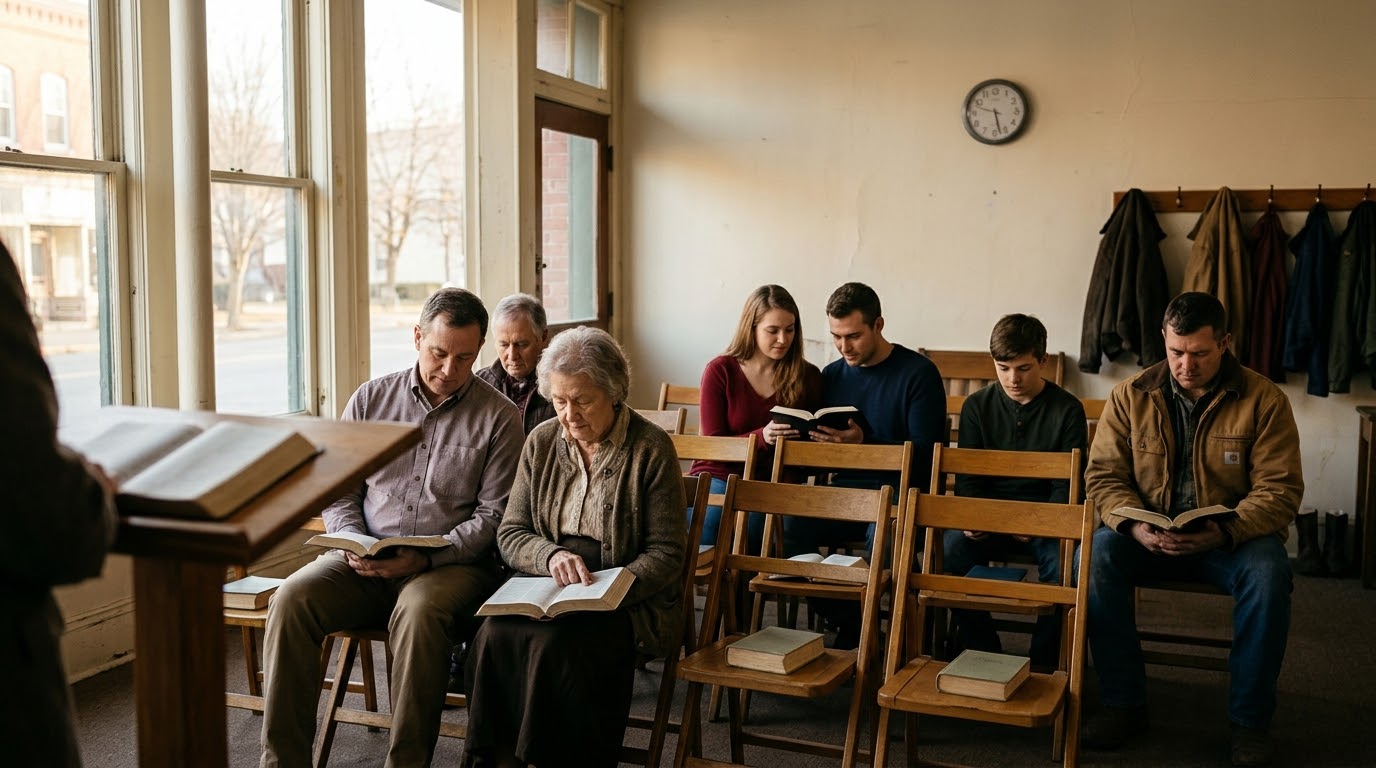
Picture your first Sunday with us. We sing out of hymnals with no instruments. A man leads a prayer in plain words. Nobody speaks in tongues, and nobody stands up to say the Spirit just told him something new. Then someone opens the Bible and spends a good while reading it and explaining it.
If you've come from a church where the Spirit was something you felt in the room, that might seem thin. You might walk out wondering whether we believe in Him at all. We do. In fact, our worship looks the way it does because of what He wrote.
Who He Is
In Acts 5, a man named Ananias sold a piece of land, kept part of the money for himself, and laid the rest at the apostles' feet as if it were the whole price. Peter said to him, "Ananias, why has Satan filled your heart to lie to the Holy Spirit and to keep back for yourself part of the proceeds of the land?" And then, "You have not lied to man but to God" (Acts 5:3-4). Do you see what Peter did there? A lie to the Spirit was a lie to God.
David asked, "Where shall I go from your Spirit? Or where shall I flee from your presence?" (Psalm 139:7). Well, nowhere. And only God is everywhere.
Jesus sent His apostles out "baptizing them in the name of the Father and of the Son and of the Holy Spirit" (Matthew 28:19).
A note on the Greek: "In the name" is eis to onoma, and onoma, "name," is singular. Jesus didn't say "in the names." One name, and three who share it.
Now think about what the Spirit does in the New Testament. He speaks. "The Holy Spirit said, 'Set apart for me Barnabas and Saul'" (Acts 13:2). He makes choices, giving gifts "to each one individually as he wills" (1 Corinthians 12:11). He intercedes for us when we don't know what to pray (Romans 8:26). And Paul warns Christians, "do not grieve the Holy Spirit of God" (Ephesians 4:30). Is that a force? No. You can't grieve electricity. You can only grieve a person.
A note on the Greek and Hebrew: In the Old Testament the word for Spirit is rûaḥ, which also means breath or wind, and it's usually feminine. In the New Testament it's pneuma, which is neuter. So you'd expect "it." But Jesus keeps saying ekeinos, "he" (John 14:26; 16:13). Now keep in mind, in those verses "he" may be pointing back to paraklētos, "Helper," which is a masculine word, so the grammar by itself doesn't settle anything. What settles it is what He does. He teaches, He hears, He speaks, He guides (John 16:13). That's a person.
The Book He Gave
Jesus told His apostles, "But the Helper, the Holy Spirit, whom the Father will send in my name, he will teach you all things and bring to your remembrance all that I have said to you" (John 14:26). That promise was for the Twelve, the men who would preach the gospel and write the New Testament, and Jesus said the Spirit would guide them "into all the truth" (John 16:13). Paul said the same thing about his own preaching. He spoke "in words not taught by human wisdom but taught by the Spirit" (1 Corinthians 2:13).
It was that way before them too. David said, "The Spirit of the LORD speaks by me; his word is on my tongue" (2 Samuel 23:2). And Peter tells us the prophets "spoke from God as they were carried along by the Holy Spirit" (2 Peter 1:21).
A note on the Greek: "Carried along" is pheromenoi. Luke uses the same verb in Acts 27 when Paul's ship gets caught in a storm and they couldn't steer, so "we gave way to it and were driven along" (Acts 27:15). The prophets were moved by the Spirit the way that ship was moved by the wind. And when Paul says all Scripture is "breathed out by God" (2 Timothy 3:16), the word is theopneustos, with pneuma right there inside it.
So when we open the Bible on Sunday, we're not setting the Spirit aside to do something else. We're opening "the sword of the Spirit, which is the word of God" (Ephesians 6:17).
Why Our Worship Looks Like This
Paul wrote to the Ephesians, "be filled with the Spirit, addressing one another in psalms and hymns and spiritual songs, singing and making melody to the Lord with your heart" (Ephesians 5:18-19). To the Colossians he wrote, "Let the word of Christ dwell in you richly, teaching and admonishing one another in all wisdom, singing psalms and hymns and spiritual songs, with thankfulness in your hearts to God" (Colossians 3:16).
Put those two side by side. Being filled with the Spirit and letting the word of Christ live in you richly lead to the very same thing: people singing to one another, and to God, from the heart. That's the singing you'll hear on a Sunday morning. It's quiet next to a band, I'll grant you that. But it's what the Spirit asked for.
And in the one chapter of the Bible most taken up with spiritual gifts, Paul wrote, "For God is not a God of confusion but of peace" (1 Corinthians 14:33), and "all things should be done decently and in order" (1 Corinthians 14:40). And he wrote that to a church that wasn't lacking in any spiritual gift (1 Corinthians 1:7).
What He Does About Sin
Our deepest problem is sin. Every one of us has sinned (Romans 3:23), and sin separates us from God. Jesus said the Spirit would "convict the world concerning sin" (John 16:8). How? Through His message, because "faith comes from hearing, and hearing through the word of Christ" (Romans 10:17).
You can watch it happen at Pentecost. Peter preached Jesus crucified and raised, and the people "were cut to the heart, and said to Peter and the rest of the apostles, 'Brothers, what shall we do?'" (Acts 2:37). Now, there was a sound like a mighty rushing wind that morning (Acts 2:2), but Luke doesn't say that's what cut them. He says it was "when they heard this." Peter answered, "Repent and be baptized every one of you in the name of Jesus Christ for the forgiveness of your sins, and you will receive the gift of the Holy Spirit" (Acts 2:38). Paul calls that new birth "the washing of regeneration and renewal of the Holy Spirit" (Titus 3:5). The Spirit is God's gift "to those who obey him" (Acts 5:32).
Where He Lives Now
Paul wrote, "You, however, are not in the flesh but in the Spirit, if in fact the Spirit of God dwells in you. Anyone who does not have the Spirit of Christ does not belong to him" (Romans 8:9). And he asked, "Or do you not know that your body is a temple of the Holy Spirit within you, whom you have from God?" (1 Corinthians 6:19).
We believe that just as it's written. Christians in congregations like ours have studied for a long time how He dwells in us, and we don't all explain it the same way, so we keep to what the verses say. The change He brings is plain enough, though. Paul calls it "the fruit of the Spirit," and it looks like love, joy, peace, patience, kindness, goodness, faithfulness, gentleness and self-control (Galatians 5:22-23).
A note on the Greek: "Fruit" is karpos, and it's singular. Paul doesn't hand us nine fruits to pick from, as if one Christian gets patience and another gets kindness. It's one harvest, and the Spirit grows all of it.
What About Miracles and Tongues?
This is usually the next question, and it's a fair one. We believe the miraculous gifts, such as prophecy and tongues, were given to reveal the word and to confirm it. The gospel "was declared at first by the Lord, and it was attested to us by those who heard, while God also bore witness by signs and wonders and various miracles and by gifts of the Holy Spirit" (Hebrews 2:3-4). The apostles preached, and the Lord was "confirming the message by accompanying signs" (Mark 16:20).
And by the way, here's a point that sometimes gets overlooked. Those gifts were passed on through the apostles' hands (Acts 8:18). When the apostles died, there was no one left to pass them on.
Paul said prophecy and tongues would cease and pass away, "but when the perfect comes, the partial will pass away" (1 Corinthians 13:8-10).
A note on the Greek: "The perfect" is to teleion, which means complete or full-grown. It's neuter, so it's a "thing" and not a "him." Paul is talking about the partial revelation giving way to the complete, the faith "once for all delivered to the saints" (Jude 3).
So does that mean God doesn't do anything anymore? Not at all. God still answers prayer, and we pray to Him for the sick and the hurting every week. But a feeling never outranks what the Spirit wrote. John tells us, "Beloved, do not believe every spirit, but test the spirits to see whether they are from God" (1 John 4:1). And what do you test them by? Well, by the book He gave.
We're one independent congregation, with no denomination or headquarters behind us. Other congregations that follow the New Testament pattern generally teach what you've read here, but none of us speaks for the rest.
Read It With Us
If you'd like to read John 14 through 16 with someone, where Jesus says the most about the Spirit, Drew De Grado, our evangelist, or any of us would be glad to sit down with you. You can schedule a Bible study, learn who we are, or contact us with a question.
Our gatherings:
We meet at 416 Main Street, Suite D, in Honesdale, PA 18431. Park behind the building and come in at the rear entrance.