
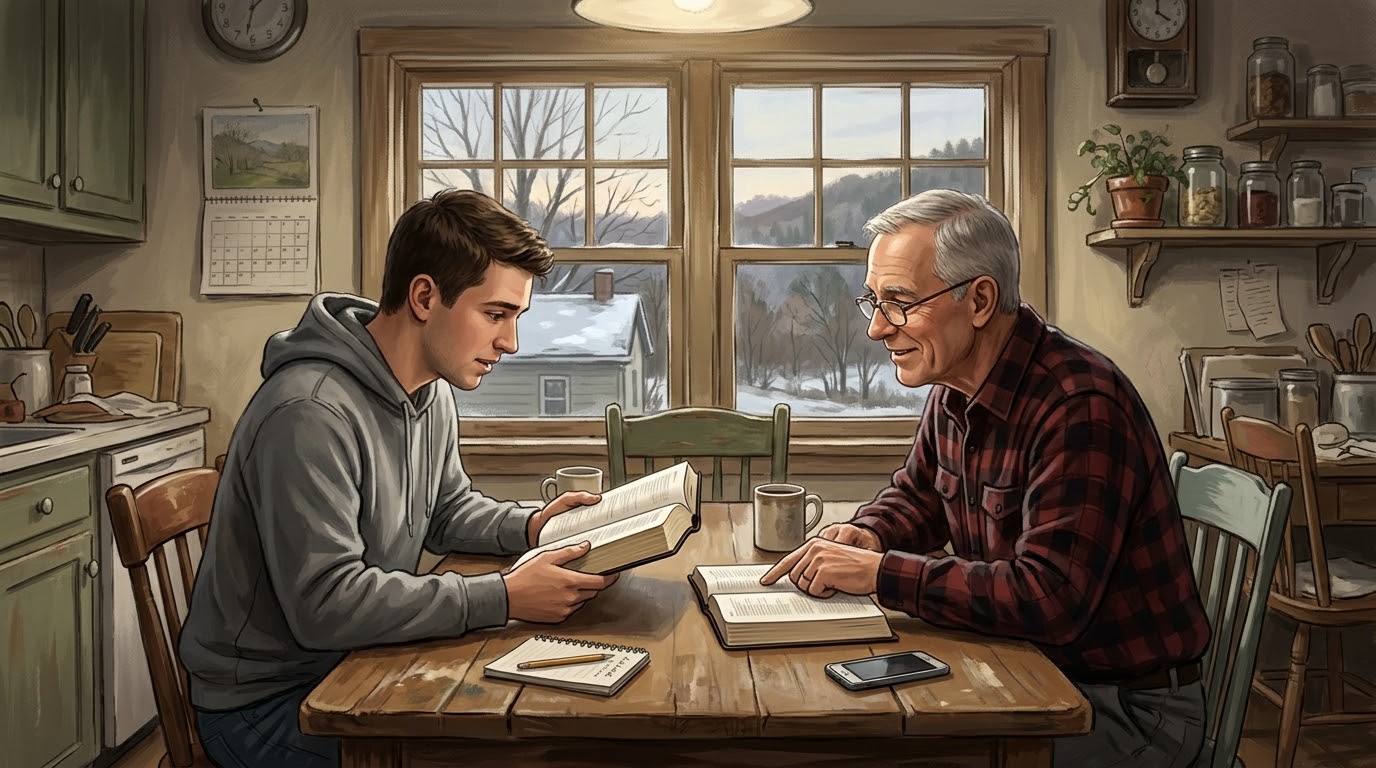
Here at Christians In Honesdale, you don't need to know anything about the Bible to sit in on worship or a Bible study with us. Nobody will quiz you or call on you, and nobody expects you to know where anything is. You're free to listen, and to ask when something puzzles you.
The Moment You Open One
Someone hands you a Bible. It's thick, the print is small, and there are little numbers scattered all through the lines. Somebody up front says "Romans 10," and pages start turning all around you while you're still looking for the front cover. Sound familiar?
Well, almost everyone who reads the Bible now started out right there, whether they'd admit it or not. The pages and numbers make sense in about two minutes once someone shows you how they work.
How the Book Is Put Together
The Bible is really a small library, 66 books bound in one cover. The Old Testament has 39 of them, written before Jesus came. The New Testament has 27, and it tells about His life and the first Christians.
When you see a reference like Romans 10:17, "Romans" is the book, 10 is the chapter and 17 is the verse. Chapters get the big numbers, and verses get the little ones inside the text. To find Romans, open the table of contents in the front, find the page number and turn there. Nobody will think less of you for using it. I mean, plenty of us still do.
By the way, those numbers weren't part of what Moses or Paul wrote. They were added centuries later so readers could find their place. The chapter divisions came in the 1200s, and the verse numbers we use in the New Testament were added in 1551 by a French printer named Robert Estienne. So if a thought seems to stop at the end of a chapter, keep reading. It probably doesn't.
A couple of things trip up nearly every beginner. Some books carry a number in front of the name, like 1 John, 2 John and 3 John. Those are short letters near the back, not the Gospel of John. And when someone says "Psalm 23," that's one psalm, so you'll find it in the book of Psalms.
Own a Bible? Bring it. Any Bible is fine. On this blog we quote the English Standard Version (ESV), but the King James or whatever's on your shelf will do, and a Bible app on your phone works too.
Sitting In on a Study
Our Sunday Bible study meets at 11am, right after worship at 10am. Whoever is teaching leads, and the rest of us read along. You won't be asked to read aloud or to answer anything, and you can stay quiet the whole hour if you'd like. You're also welcome to come for worship and skip the study.
A good teacher explains as he goes, including words like "gospel," which means the good news about Jesus. That's nothing new, by the way. When God's people came home to Jerusalem after the exile, Ezra read the Law to the whole crowd, and men stood among them helping them follow it. "They read from the book, from the Law of God, clearly, and they gave the sense, so that the people understood the reading" (Nehemiah 8:8). Reading it clearly and giving the sense is still the job.
We're an independent congregation with no denomination or headquarters behind us, so we can only tell you how we do it. Other congregations that follow the New Testament pattern generally teach this way too, but each one arranges its own studies.
Where to Start Reading the Bible on Your Own
So where do you begin? Start with Jesus. You can start at Genesis, of course, and some people do, but a lot of them run out of steam somewhere in the middle of Leviticus.
Mark is the shortest of the four Gospels, the books about His life, death and resurrection. John is longer and tells you why it was written: "but these are written so that you may believe that Jesus is the Christ, the Son of God, and that by believing you may have life in his name" (John 20:31). Read one of them, then Acts, which shows what happened when people first heard about Jesus. A chapter at a time is plenty. Keep a list of what you don't follow, and bring the list with you. We'd much rather hear your questions than have you sit on them.
You'd Be in Good Company
In Acts 8 an official from Ethiopia was riding home in his chariot. He wasn't new to religion. He was in charge of the queen's treasury, and he'd traveled all the way to Jerusalem to worship (Acts 8:27). Now he was reading Isaiah out loud on the road. Philip came alongside and asked, "Do you understand what you are reading?" And he said, "How can I, unless someone guides me?" (Acts 8:30-31).
A note on the Greek: Luke's wording has a play on words you can't quite carry into English. "Do you understand what you are reading?" is ginōskeis ha anaginōskeis, roughly "Do you know what you're reading?", because the Greek word for reading, anaginōskō, is built on the word for knowing. And "guides me" is hodēgēsei, from hodos, "road," and a verb meaning "to lead." So a man riding down a road asks for someone to show him the way. Jesus used the same verb for the Holy Spirit guiding the apostles "into all the truth" (John 16:13).
He was stuck, and he said so. He invited Philip up to sit with him, and he asked the question any of us might ask: "About whom, I ask you, does the prophet say this, about himself or about someone else?" (Acts 8:34). Philip began right at that passage and told him the good news about Jesus (Acts 8:35). Before the ride was over, the man pointed and said, "See, here is water! What prevents me from being baptized?" (Acts 8:36-38).
Even the apostles needed help with it. After the resurrection, Jesus "opened their minds to understand the Scriptures" (Luke 24:45). Asking somebody to explain isn't a sign you're behind.
Why the Bible Matters So Much
Not knowing Scripture isn't what keeps a person from God. Sin is, and every one of us has sinned and fallen short of God's glory (Romans 3:23). The Bible is where God tells us so, and where He shows us what He did about it in Christ.
"So faith comes from hearing, and hearing through the word of Christ" (Romans 10:17). Timothy grew up with these writings, learning them from his grandmother Lois and his mother Eunice (2 Timothy 1:5; 3:14). Paul reminded him that "from childhood you have been acquainted with the sacred writings, which are able to make you wise for salvation through faith in Christ Jesus" (2 Timothy 3:15). Now, if a child could follow them, don't you think you can?
A psalm promises, "The unfolding of your words gives light; it imparts understanding to the simple" (Psalm 119:130). "The simple" are people without much learning or experience. God's word was meant to reach them.
A note on the Hebrew: "Unfolding" is pēṯaḥ, an opening or doorway. It's the word for the door of Abraham's tent (Genesis 18:1). "The simple" are the pəṯāyîm, people who are open, inexperienced and easily led. Proverbs warns that "the simple believes everything" (Proverbs 14:15). In Hebrew the two words sound alike. When God's words are opened up, light comes in, and it comes in for exactly the person who knows the least.
Ask Anything
When Paul preached in Berea, the people there "received the word with all eagerness, examining the Scriptures daily to see if these things were so" (Acts 17:11). Bring your questions to us the same way, and check what we say. You can ask during a study or after it. You can also ask in the online study on a Tuesday night, from your own kitchen table, where nobody sees you hunting for the page.
Read It With Us
If you'd like to try a study from home first, join our Tuesday online Bible study at 7pm on Google Meet. If you'd rather go one-on-one at your own pace, you can schedule a Bible study on our website. You can also learn who we are or contact us with a question for Drew De Grado, our evangelist.
Our gatherings:
We're at 416 Main Street, Suite D, in Honesdale, PA 18431. The door isn't on Main Street, so park behind the building and come in the rear entrance.