
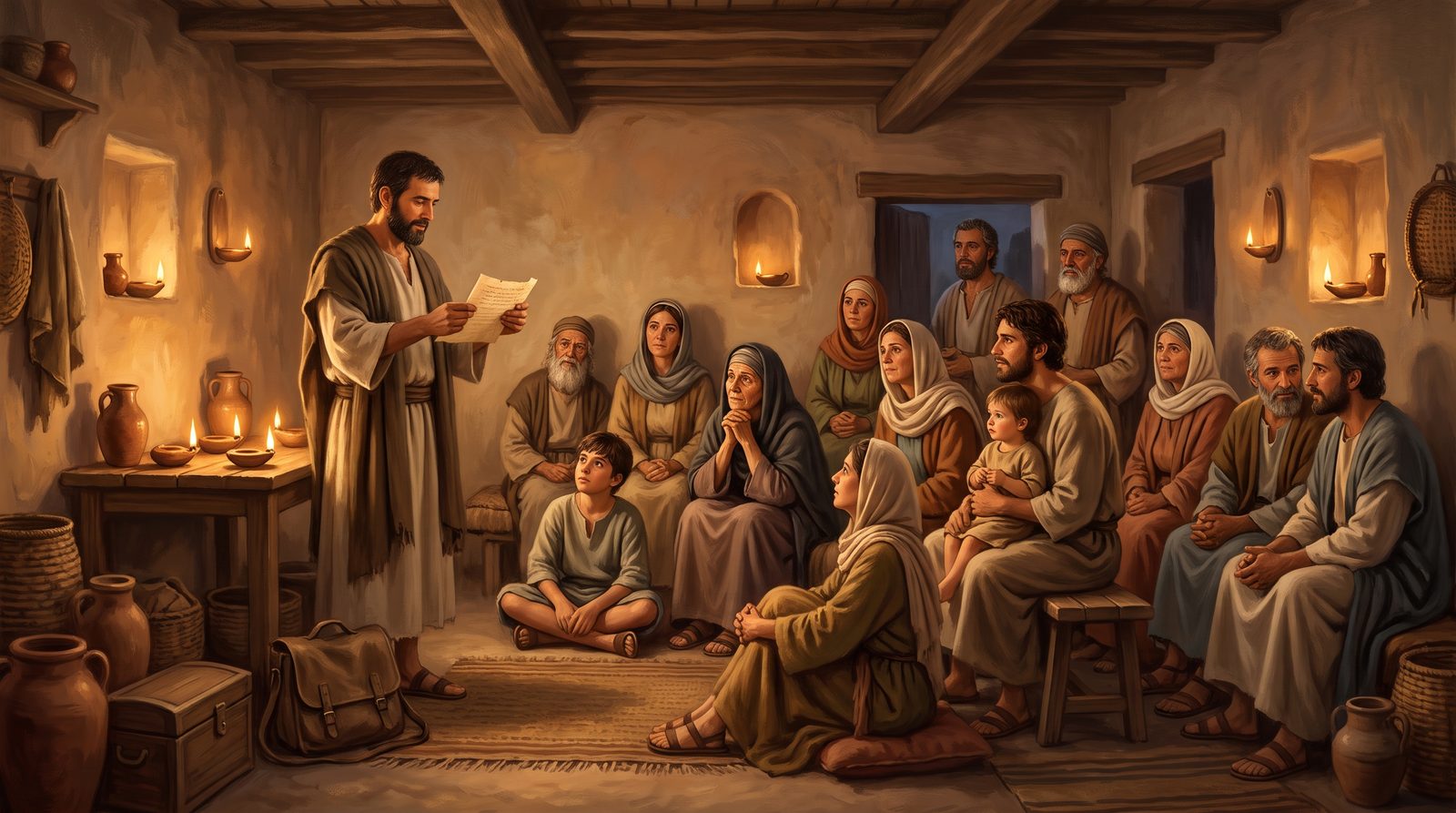
We and our Orthodox neighbors look back to the same Jesus and the same apostles, but we part ways over authority. Orthodox Christians receive the Bible as the first and central part of Holy Tradition, which they describe as the life of the church as the Holy Spirit guides it. That tradition also takes in the early councils, the writings of the church fathers and the liturgy, and they're led by bishops. Icons, prayers to the saints, the baptism of babies and the shape of a Sunday morning all grow out of that one root. Here at Christians In Honesdale, we go by the New Testament alone, and the pattern we find there puts each congregation under its own elders, with nobody above them but Christ (Acts 14:23).
A Family of Churches With No Pope
The Eastern Orthodox Church is a family of self-governing churches in full communion with each other. The Greek and Russian churches belong to it, and so do the Antiochian and Serbian churches, among others. The Patriarch of Constantinople is honored as first among equals. He doesn't rule the others. Orthodoxy has nothing like the papacy, and the break between the Orthodox and Roman Catholics is traditionally dated to 1054.
Coptic and Armenian churches are another matter. They belong to a separate family, the Oriental Orthodox, and we're leaving them aside here.
Ground We Hold in Common
There's more than people tend to expect. Orthodox Christians confess Jesus as true God and true man. The Nicene Creed, which they confess, speaks of "one baptism for the remission of sins," and they baptize by immersion, which we do as well, because Paul describes baptism as a burial (Romans 6:4). They celebrate the Divine Liturgy, their service of Holy Communion, every Lord's Day, and we observe the Lord's Supper every Sunday, following the first Christians (Acts 20:7).
Even the music lines up. The Orthodox Church in America says the tradition of the Orthodox Church is to have no musical instruments in worship, though it notes that organs turn up in some Greek and a few Antiochian parishes in the United States.
We'd also say Amen to what the Nicene Creed says about Christ. We just get there by a different road. We believe Jesus is God because John wrote, "In the beginning was the Word, and the Word was with God, and the Word was God" (John 1:1), not because a council voted on it in the fourth century.
Holy Tradition and the Apostles' Letters
In Orthodox teaching, Scripture holds the first place within Holy Tradition, alongside the church's liturgy, its councils and the writings of the fathers. Orthodox writers often point to what Paul wrote to the Thessalonians: "So then, brothers, stand firm and hold to the traditions that you were taught by us, either by our spoken word or by our letter" (2 Thessalonians 2:15).
We take that command seriously too. But look at who's teaching. It's "us," Paul and other men with him, passing on the gospel in person and in writing. We understand those traditions to be the apostles' own teaching under the guidance of the Holy Spirit, and that teaching reaches us today in the New Testament.
A note on the Greek: "Traditions" is paradoseis, from paradosis, "something handed over." It isn't a bad word. Paul praises the Corinthians for holding to the traditions he delivered (1 Corinthians 11:2). But Jesus used the same word when He told the Pharisees, "You leave the commandment of God and hold to the tradition of men" (Mark 7:8). So the question is never whether a church has tradition. It's who handed it over. In 2 Thessalonians 2:15 the answer is the apostles, and the verb is past tense (edidachthēte, "you were taught"). Paul points back to teaching already given, not to teaching still to come in the future.
Paul told Timothy that Scripture is given "that the man of God may be complete, equipped for every good work" (2 Timothy 3:17). If it leaves a Christian complete, nothing written later has to be added. Jude urged Christians "to contend for the faith that was once for all delivered to the saints" (Jude 3).
A note on the Greek: "Complete" is artios, fit and fully able, and "equipped" is exērtismenos, a perfect participle meaning thoroughly furnished, with nothing missing. In Jude 3, "delivered" is paradotheisē, the verb that sits behind paradosis. So the tradition was delivered, and Jude adds hapax, "once for all," the word Hebrews uses for Christ's one sacrifice (Hebrews 9:26-28). A faith handed over once for all isn't still being handed over.
So while we're happy to learn from the old councils, we don't treat what they decided as binding on a Christian. The bishops who sat in them, however devout and however close to the early centuries, weren't apostles.
Bishops in Succession, Elders in Each Congregation
An Orthodox church is led by its bishop. Priests, also called presbyters, assist him and lead the local congregations, and deacons serve alongside them. Orthodox bishops stand in apostolic succession, a line of ordination they trace back to the apostles, and the bishops of a region meet together in council.
We have no hierarchy. None. "And he is the head of the body, the church" (Colossians 1:18). Paul and Barnabas appointed elders in every church (Acts 14:23). Elders are the men who oversee a congregation, and Peter told them to "shepherd the flock of God that is among you" (1 Peter 5:2). That's one congregation, not a region.
In the New Testament, "elder" and "bishop" are two names for the same men. Paul "sent to Ephesus and called the elders of the church to come to him" (Acts 20:17), and then told those same elders, "Pay careful attention to yourselves and to all the flock, in which the Holy Spirit has made you overseers" (Acts 20:28). He told Titus to "appoint elders in every town" and in the next breath said, "For an overseer, as God's steward, must be above reproach" (Titus 1:5, 7).
A note on the Greek: "Elder" is presbyteros, an older man. "Overseer" is episkopos, the word that became "bishop" in English. "Shepherd" is poimainō, the verb behind "pastor." In Acts 20 and 1 Peter 5 all three describe one group of men in one congregation. The first writer to set a single bishop over a group of elders is Ignatius of Antioch, around AD 110, after the apostles had died. In the fourth century Jerome, whom the Orthodox honor as a saint, wrote in his commentary on Titus that elders and bishops were originally the same.
The New Testament also never calls a church leader a priest. The word for a priest who offers sacrifice is hiereus, and the New Testament uses it for every Christian: "you are a chosen race, a royal priesthood, a holy nation, a people for his own possession" (1 Peter 2:9; see also 2:5). Oddly enough, the English word "priest" comes from presbyteros.
We hold ourselves to that pattern, and there's one place where we're still on the way. We're a small congregation of fewer than twenty members, and right now none of our men meet the qualifications Paul lays out for elders (1 Timothy 3:1-7; Titus 1:5-9). So we don't have elders yet, and we won't appoint anyone just to fill the title. That isn't unusual in the New Testament. Paul and Barnabas planted churches and came back later to appoint elders (Acts 14:21-23), and Paul left Titus in Crete to appoint elders where congregations were already meeting (Titus 1:5). Until the Lord raises up qualified men among us, we work together as a congregation under Christ and His word.
So we can't speak for anybody else. We're an independent congregation with no denomination or headquarters behind us, and churches that read the Bible the way we do don't take direction from us, or we from them. You're reading what's taught here.
Icons, Mary and the Saints
Step inside an Orthodox church and you'll see icons. The Seventh Ecumenical Council, a gathering of bishops held at Nicaea in 787, said icons receive honorable reverence, which the Orthodox call veneration, and not the true worship that belongs to God alone. Because the Son of God became flesh, they teach, He can be pictured, and the honor shown an icon passes to the person it portrays. Orthodox Christians also ask Mary and the saints to pray for them. Orthodox teachers call the saints intercessors, not mediators, and compare their prayers to Christians on earth praying for one another. They add that the saints aren't dead to God, since Jesus said "all live to him" (Luke 20:38).
A note on the Greek: Nicaea II drew its line between proskynēsis, bowing in honor, and latreia, the service owed to God. But the Greek Old Testament that the early church read puts both words side by side in the second commandment: "You shall not make for yourself a carved image... You shall not bow down to them or serve them" (Exodus 20:4-5). There the Septuagint has ou proskynēseis and oude mē latreusēs. The New Testament uses proskyneō when Cornelius fell at Peter's feet "and worshiped him," and Peter answered, "Stand up; I too am a man" (Acts 10:25-26). John did the same before an angel and was told, "You must not do that! I am a fellow servant with you... Worship God" (Revelation 22:8-9). Neither of them was mistaking Peter or the angel for God. They were showing honor, and it was refused.
The Orthodox would answer that the second commandment forbids idols, not pictures of the God who became man, and that God Himself ordered cherubim worked into the tabernacle (Exodus 25:18). That's a fair point about images. But nobody in Israel was told to bow to the cherubim or kiss them. And Israel's history shows what can happen even to an image God commanded. Moses made the bronze serpent at God's word (Numbers 21:8-9). Centuries later Hezekiah "broke in pieces the bronze serpent that Moses had made, for until those days the people of Israel had made offerings to it" (2 Kings 18:4).
A note on the Hebrew: The people called it Nəḥuštān, a name that plays on nəḥōšet, "bronze," and nāḥāš, "serpent." It's close to a shrug: "a bronze snake thing." Hezekiah wouldn't let a holy memory become an object of devotion, and Scripture praises him for it. "He trusted in the LORD, the God of Israel" (2 Kings 18:5).
On the saints, the Orthodox cite the same verse we lean on. Paul wrote, "For there is one God, and there is one mediator between God and men, the man Christ Jesus" (1 Timothy 2:5). We differ on whom we ask. In the New Testament, believers ask each other for prayer and bring their own requests to the Father through Jesus (Matthew 6:9; John 14:6). None of them prays to someone who has died, and images never show up in the church's worship. We leave both out.
Who Gets Baptized, and What the Bread Is
The Orthodox baptize infants as well as adults. The person is immersed three times, in the name of the Father, the Son and the Holy Spirit, and a godparent answers for a baby. Chrismation, an anointing with holy oil, always comes with baptism, and after it even a small child may receive Communion.
We baptize people old enough to believe and to repent, which means turning from sin to God. Jesus said, "Whoever believes and is baptized will be saved" (Mark 16:16), and Peter told the crowd at Pentecost to repent and be baptized (Acts 2:38). In Samaria, "when they believed Philip as he preached good news about the kingdom of God and the name of Jesus Christ, they were baptized, both men and women" (Acts 8:12). A baby can't yet believe or repent.
What about the households in Acts? The Philippian jailer is the case Orthodox writers raise most often, and it's worth reading closely. Paul and Silas "spoke the word of the Lord to him and to all who were in his house." Then he was baptized with his family, and afterward "he rejoiced along with his entire household that he had believed in God" (Acts 16:32-34). The only ones baptized that night were the same ones who heard the word and believed it.
Communion is the other place we part. Orthodox teaching holds that the Holy Spirit changes the bread and wine into the very Body and Blood of Christ, a mystery they say no rational explanation can capture. We observe the Lord's Supper on the first day of every week as a remembrance of Jesus and a sharing in Him (1 Corinthians 11:24-26; 10:16).
A note on the Greek: "Do this in remembrance of me" uses anamnēsis, a calling to mind that makes the past present to the worshiper, not a passing thought. And Paul asks, "The cup of blessing that we bless, is it not a participation in the blood of Christ?" (1 Corinthians 10:16). "Participation" is koinōnia, fellowship or sharing. So the Supper is no empty ritual to us. We commune with the Lord at His table. What we don't find in the text is a change in what the bread and cup are. Paul still calls them bread and the cup after the blessing (1 Corinthians 11:26-28).
Chant and Incense, or Voices Alone
A Divine Liturgy is full of chant and incense, with vestments, icons and prayers that follow a set text. Ours is plain. The first Christians "devoted themselves to the apostles' teaching and the fellowship, to the breaking of bread and the prayers" (Acts 2:42), and that's the shape we keep. We sing a cappella, meaning voices with no instruments (Ephesians 5:19). We pray, observe the Lord's Supper, hear the Bible preached and give on the first day of the week (1 Corinthians 16:2), and we try to offer all of it in spirit and truth (John 4:24). We don't add to it.
If you visit, that worship happens in Suite D at 416 Main Street, and the door you'll use is at the back.
Start With Acts
Take your time. Read the book of Acts, then the letters after it, and watch how the first congregations were led and what they did when they met. Then hold every church you've known up against what you read, ours included.
Open 2 Thessalonians With Us
Maybe you were raised Orthodox, or maybe you've been visiting a parish and have questions you'd like to talk through. We'd be glad to read these passages with you, either one-on-one or in our Tuesday night study online. Ask for a Bible study, learn who we are, or drop us a note before you come.
Sundays and Tuesdays:
Sunday mornings find us at 416 Main Street, Suite D, Honesdale, PA 18431. Pull in behind the building to park, and come in through the rear entrance.