
Jesus did. He promised to build His church, and the New Testament shows it beginning in Jerusalem on the day of Pentecost, a Jewish feast day, a few weeks after He rose from the dead. Alexander Campbell was a preacher in the 1800s who urged people to go back to that church. He didn't start it, and he'd have been the first to tell you so.
His name comes up whenever someone looks into congregations like Christians In Honesdale, so we'll tell the story ourselves.
A Few Preachers Who Wanted Fewer Labels
In the early 1800s, several American preachers from Presbyterian backgrounds grew uneasy with how Christians had split into rival denominations. Each group had its own creed, a written statement of faith its members were expected to accept. Barton W. Stone was one of these preachers. He preached in Kentucky. In 1804 he and a handful of fellow preachers dissolved their presbytery, the regional body that governed their churches. Their document said the body should "sink into union with the Body of Christ at large." From then on they chose to be called Christians and nothing else.
Thomas Campbell had come from Ireland to Washington County, in western Pennsylvania, in 1807. In 1809 he published a plea for believers to unite on the Bible alone. A motto usually credited to him from that year sums it up: "Where the Scriptures speak, we speak; where the Scriptures are silent, we are silent." His son Alexander arrived that same year. For about fifteen years, beginning in 1815, the Campbells and their small congregations belonged to Baptist associations, trying to work inside a church that already existed. Over time Alexander became the best-known voice of the effort. He spent decades preaching, editing papers and debating, and his following spread across the frontier. Early in the 1830s many of Stone's congregations and the Campbells' joined hands.
Other people were saying the same thing with no tie to either man. In Virginia in the 1790s, James O'Kelly and the preachers with him left the Methodists and took the name Christian. Around 1800 in New England, Abner Jones and Elias Smith did much the same, on their own. People reading the same Bible kept reaching the same conclusion.
People now call all this the Restoration Movement, or the Stone-Campbell Movement. Plenty of American congregations that wear the name church of Christ, and others that go simply by Christian, trace their local beginnings to it. That's history. None of it embarrasses us. Even the name isn't Campbell's. He preferred "Disciples," and Stone preferred "Christians." "Church of Christ" comes from Paul: "All the churches of Christ greet you" (Romans 16:16). It describes whose church it is. It isn't the name of a denomination.
The Church Jesus Called His Own
Jesus said He would do the building Himself: "And I tell you, you are Peter, and on this rock I will build my church, and the gates of hell shall not prevail against it" (Matthew 16:18). The church is His.
A note on the Greek: "I will build my church" is oikodomēsō mou tēn ekklēsian. The verb is future tense. When Jesus spoke these words, the church was still to come. The pronoun mou, "my," settles whose it is. Ekklēsia means an assembly of people called together. Jesus is the builder, and He's the owner.
The prophets had already said where and when it would begin. Isaiah wrote that "in the latter days" the nations would stream to the house of the LORD, "for out of Zion shall go the law, and the word of the LORD from Jerusalem" (Isaiah 2:2-3). After His resurrection, Jesus told the apostles that repentance and forgiveness would be preached in His name to all nations, "beginning from Jerusalem" (Luke 24:47).
A note on the Hebrew: "In the latter days" is bəʾaḥărît hayyāmîm, literally "at the end of the days." When Peter stood up at Pentecost, he began by quoting the prophet Joel with the same idea: "And in the last days it shall be, God declares…" (Acts 2:17). Peter was telling the crowd that the days the prophets pointed to had arrived, and the place was Jerusalem.
He kept that promise at Pentecost. Peter preached and told the crowd to repent and be baptized for the forgiveness of their sins (Acts 2:38). Luke, who wrote Acts, reports what followed: "So those who received his word were baptized, and there were added that day about three thousand souls" (Acts 2:41). From then on, the Lord kept adding the saved (Acts 2:47).
Paul says that foundation was laid once and can't be swapped for another: "For no one can lay a foundation other than that which is laid, which is Jesus Christ" (1 Corinthians 3:11). The church has one head, too. "And he is the head of the body, the church" (Colossians 1:18). Christ bought it with His own blood (Acts 20:28). So a preacher in the 1800s had nothing to found. He could only serve the church Christ had already built.
Going Back Isn't Starting Over
Stone and the Campbells were trying to get back to the church they read about in the New Testament. Stone's group said they wanted their own body to dissolve into the one body of Christ. The Campbells never handed anyone a replacement creed. They only asked people to set the old ones down and read the New Testament for themselves.
The idea is older than America. Through Jeremiah, God told a people who had wandered: "Stand by the roads, and look, and ask for the ancient paths, where the good way is; and walk in it, and find rest for your souls" (Jeremiah 6:16).
A note on the Hebrew: "Ancient paths" is nətîbôt ʿôlām, the paths of long ago. God didn't ask Judah to invent a new way. He told them to find the old one and walk in it.
King Josiah did exactly that. While the temple was being repaired, the high priest found the Book of the Law, which had been neglected for years (2 Kings 22:8). Josiah had it read to the people, cleared out the idols, and kept the Passover the way the Law described. The Bible says, "For no such Passover had been kept since the days of the judges who judged Israel, or during all the days of the kings of Israel or of the kings of Judah" (2 Kings 23:22). Nobody says Josiah founded Israel's faith. He went back to it.
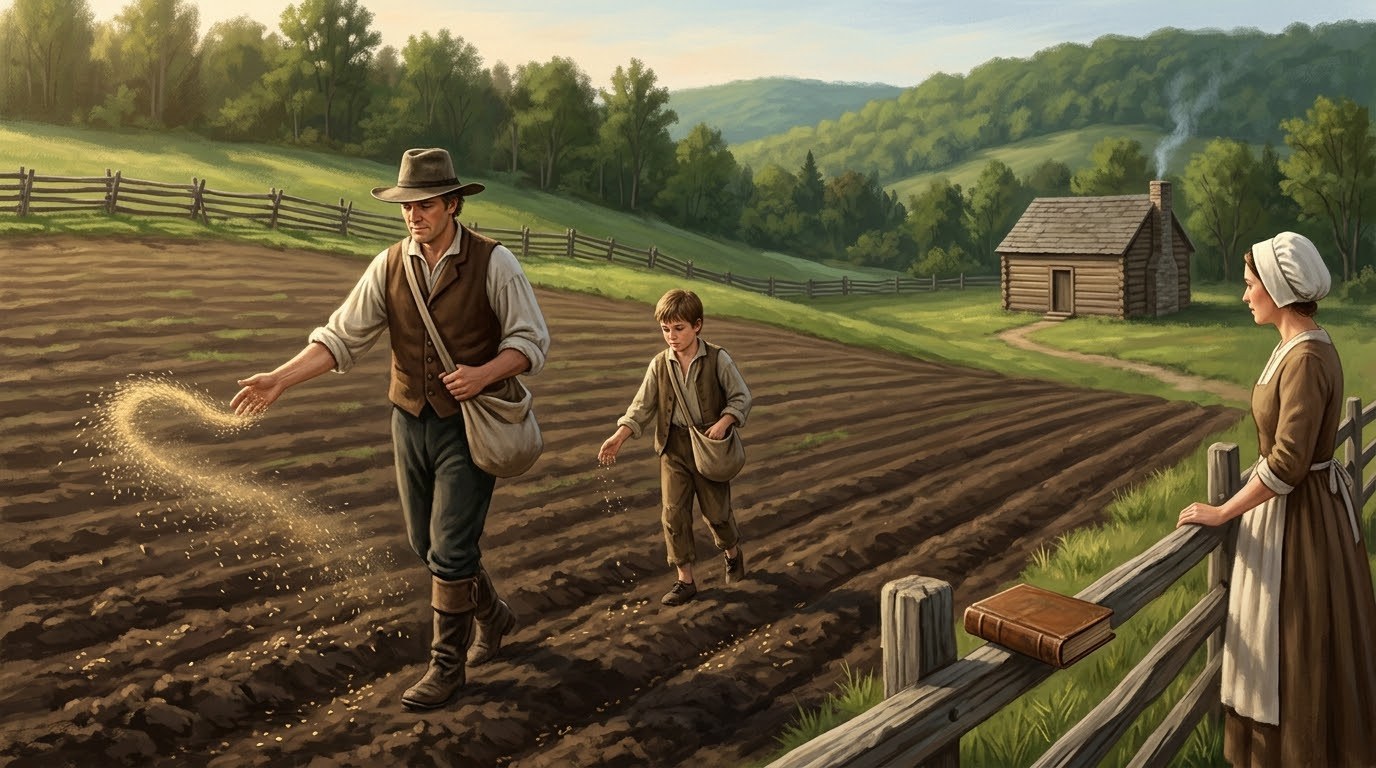
Jesus compared God's word to seed: "Now the parable is this: The seed is the word of God" (Luke 8:11). Wheat planted in Kentucky in 1804 comes up wheat, the same as wheat sown in Judea in the first century. Peter says Christians are "born again, not of perishable seed but of imperishable, through the living and abiding word of God" (1 Peter 1:23). When people plant God's word and obey it the way the apostles taught it, they get the church the apostles knew.
A note on the Greek: In Luke 8:11 the seed is sporos, and in 1 Peter 1:23 the word is spora, with the adjective aphthartos, "imperishable." Seed that can't perish doesn't wear out between the first century and the nineteenth, or the twenty-first. Same seed, same crop.
The faith was "once for all delivered to the saints" (Jude 3). It doesn't depend on an unbroken chain of buildings or bishops reaching back to the apostles. Same seed, same church.
We also can't vouch for every congregation that came out of that history. Christians In Honesdale is an independent church. There's no headquarters and no denomination over us, so we answer for what's taught and practiced here. Other congregations speak for themselves.
Why We Won't Wear a Man's Name
Some Christians in Corinth started lining up behind favorite teachers. "I follow Paul," one would say, and another, "I follow Apollos" (1 Corinthians 1:12). Paul put a stop to it: "Is Christ divided? Was Paul crucified for you? Or were you baptized in the name of Paul?" (1 Corinthians 1:13).
A note on the Greek: "I follow Paul" is literally egō men eimi Paulou, "I am of Paul" or "I am Paul's." It's a claim of belonging. Calling someone a "Campbellite" makes the same claim, and Paul's answer is that believers belong to the one who was crucified for them.
If an apostle wouldn't let believers be named after him, we're not about to be named after Campbell or Stone. It's a big part of why we go by Christians, the name the disciples were first called in Antioch (Acts 11:26), and no other label. Campbell himself objected to the nickname "Campbellite."
We read men like him the way the people of Berea listened to Paul, checking each claim against Scripture (Acts 17:11). Sometimes we part ways with him. In the 1820s his own paper had argued that missionary societies had no place in the New Testament. Then in 1849 Campbell became the first president of one. We don't use that kind of arrangement, because in the New Testament congregations sent support to preachers directly (Philippians 4:15-16). We can admire his courage and still not follow him there. He asked people to test every teacher that way, himself included.
Later in the 1800s the movement divided over instrumental music and missionary societies. The congregations that adopted them are known today as the Christian Churches and the Disciples of Christ. That split is a sad story of its own, and we've told it in a separate post.
Start With Acts 2
The question that matters isn't who someone in history was following. It's whether a church is doing what the church in the New Testament did. Read Acts 2 slowly, maybe twice. Then look at any congregation, ours included, and ask whether you'd recognize it on those pages.
Bring Your Questions About Our History
If you'd like to read the early chapters of Acts with someone, we'd be glad to sit down with you, and history questions are welcome too. Schedule a Bible study, read who we are, or drop us a note.
Times to join us:
On Sundays we gather in Suite D at 416 Main Street, Honesdale, PA 18431. The lot is out back, and so is the door you'll walk in.